Fact-checked by the YoureNewsSource editorial team
Quick Answer
To understand AI deepfake detection, you need to know how detectors work, which tools lead in accuracy, and why real-world performance often drops 10–50 percent from lab results. Most people can evaluate the available options in under an hour, but no single tool is bulletproof, yet.
If you’re trying to figure out whether an AI deepfake detection tool can actually save your team from a convincing synthetic video, the short answer is: it depends. Current detectors can spot artifacts the human eye misses, but they still fail often enough to demand caution. A 45 percent drop in the area under the curve (AUC) for state-of-the-art image deepfake models on the in-the-wild Deepfake-Eval-2024 benchmark compared to older academic tests shows the gap between lab and life isn’t small. And that’s just for images; video and audio are even messier.
The stakes are real. In 2025, deepfakes are targeting election messaging, corporate Zoom calls, and your grandfather’s Facebook feed. A report from the UK government outlines that this technology is still in an early-stage market, even as fraud losses tied to synthetic media climb. You don’t need to become a forensic analyst, but you do need a clear-eyed view of what algorithms can and cannot do. This guide draws on 2025 benchmarks and expert voices so you can pick a path that makes sense for your threat model, whether you’re a compliance officer at a firm like JPMorgan Chase or a worried citizen.
Key Takeaways
- Open-source image detectors suffer a 45% AUC drop on real-world benchmarks relative to curated datasets, according to the Deepfake-Eval-2024 study.
- The commercial tool Bio-ID reached 98% accuracy on 300 Celeb-DF v2 videos, while the open-source SBI model scored 84.69% in a 2025 university comparison.
- Humans correctly identify only 24.5% of high-quality video deepfakes, per a 2025 test of 2,000 participants by iProov.
- Intel FakeCatcher claims 96% lab accuracy but falls to 91% on wild videos, mirroring a pattern seen across detection systems.
- Audio deepfake detection remains an unsolved problem with no tool recommended for reliable public use, as highlighted by researchers from Northwestern University, the University of Southampton, and the University of St. Thomas.
In This Guide
- Step 1: Why Does Deepfake Detection Matter More Than Ever in 2025?
- Step 2: How Do AI Deepfake Detectors Actually Analyze Content?
- Step 3: Which Deepfake Detection Tools Are Most Accurate in 2025?
- Step 4: How Big Is the Gap Between Lab Accuracy and Real-World Performance?
- Step 5: How Should You Choose and Use a Deepfake Detection Tool?
- Frequently Asked Questions
Step 1: Why Does Deepfake Detection Matter More Than Ever in 2025?
Deepfakes are no longer a novelty. They are now a vector for fraud, disinformation, and identity theft that traditional security was never designed to catch. The AI deepfake detection market has grown not because people are curious about the technology, but because the damage is piling up. In 2025, a synthetic video of a CEO can authorize a wire transfer on a video call, and a cloned voice can convince a relative to send money. The tools we built to trust our eyes and ears are obsolete. The NIST guidelines for detecting face morphs were released precisely because manipulated media is now a high-stakes operational challenge at borders, banks, and boardrooms.
How to Do This
Start by acknowledging the threat surface that matters to you. For a compliance team at a financial institution, the concern is typically KYC selfie spoofing, the kind of attack that can defeat identity verification systems used by lenders and credit bureaus like Experian. For a newsroom, it’s verifying user-generated video. Detection platforms like Sensity have catalogued tens of thousands of synthetic images and videos, and the growth curve is steep. The cost per deepfake attack is falling, and the CSIRO cybersecurity research notes the increasing deceptiveness of modern deepfakes, which means any “I’ll know it when I see it” approach is now a liability.
What to Watch Out For
A common mistake is ignoring the context where the deepfake will land. Social media platforms compress media, stripping away the high-frequency artifacts that detectors rely on. Zoom smooths video, and TikTok re-encodes everything. So a detection tool used only on pristine originals is already losing half the battle. Cybercriminals aren’t the only threat either; nation-states and political operatives have far greater resources and motivation to invest in evasion.
Only 0.1% of participants in a 2025 iProov study correctly identified all deepfake samples out of 2,000 people. The average person is practically defenseless.
Step 2: How Do AI Deepfake Detectors Actually Analyze Content?
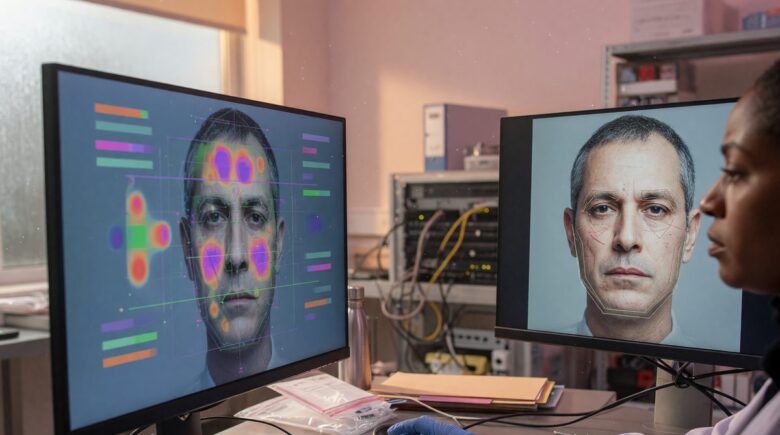
Most detectors look for the physical impossibilities that generative models can’t quite hide, irregular blinking, inconsistent lighting, and telltale patterns in the frequency domain. The core idea behind AI deepfake detection is that synthetic faces, voices, and bodies leave forensic traces that are invisible to humans but recognizable to a trained model. The best detection systems today combine pixel-level artifact analysis with biological signal tracking, such as heartbeat-induced color changes, and frequency spectrum inconsistencies. Rather than relying on one model, they fuse several approaches, something that mirrors how AI productivity tools have evolved toward ensemble methods.
How to Do This
When you evaluate a tool, ask whether it uses a multimodal pipeline. For video, a common architecture extracts frames, runs a convolutional neural network (CNN) or vision transformer on the facial region, then checks for temporal inconsistencies, unnatural motion between frames that a real face wouldn’t show. For audio, detectors analyze spectrograms for artifacts from text-to-speech synthesis, but this domain is far less mature. The Frequency Domain Analysis method spots digital “scars” left by GAN upsampling layers, which often create repeating patterns in the high-frequency spectrum. Tools like Intel FakeCatcher go further, using photoplethysmography (blood flow signals) as a liveness cue. If you’re technically inclined, models trained with self-blended images (SBI) have become a solid open-source baseline, forcing the face-swapping region to expose artifacts that even a lightweight detector can catch.
What to Watch Out For
The biggest pitfall is treating detection as a one-shot binary problem. Real deepfake creators use adversarial laundering, compressing, cropping, and re-encoding a video to strip detection clues. A detector that scores 99% on a clean sample can fall to 60% on the same video after a pass through WhatsApp. The rise of diffusion-based generation models, beyond classic GANs, also means the forensic traces that older detectors learned to spot may no longer be present. You need detectors that are continually updated, not static checkpoints from a single training run.
Random Forest classifiers with smart feature engineering have hit 99.64% accuracy on the DFDC dataset with just 2 milliseconds of inference time per frame, outperforming heavy deep learning models in speed while matching their accuracy in resource-constrained settings.
Step 3: Which Deepfake Detection Tools Are Most Accurate in 2025?
On standardized curated datasets like Celeb-DF and DFDC, several tools post high accuracy numbers, but the rankings shift once you test on content from generators they’ve never seen. For AI deepfake detection, you’ll encounter a mix of commercial platforms, open-source repositories, and academic projects. The table below distills head-to-head performance from a 2025 university comparison, noting the critical lab-vs-wild gap.
| Tool / Model | Lab Accuracy (Dataset) | Real-World Accuracy (Wild) | Cost & Access |
|---|---|---|---|
| Bio-ID | 98% (Celeb-DF v2, 300 videos) | Not publicly benchmarked | Commercial, API & on-prem solutions |
| Intel FakeCatcher | 96% (lab data) | 91% (wild videos) | Free demo available, Intel hardware |
| SBI (Open-Source) | 84.69% (Celeb-DF v2) | Significant degradation expected | Free, self-hosted |
How to Do This
Start with the open-source SBI model if you need a baseline and have technical staff to self-host. For enterprise use, Bio-ID and Sensity both offer APIs that integrate with content moderation pipelines. Test them against a small, annotated sample of real and synthetic videos from your own domain, not just clean academic datasets. Intel FakeCatcher is the only option that uses physiological signals, making it harder to fool with geometric-only fakes, but it still struggles with heavy compression. Costs vary considerably: SBI is free, while Bio-ID and Sensity range from hundreds to thousands of dollars per month depending on volume. Deepware is also worth a look, offering a user-friendly scanning interface for quick triage on social media clips.
One honest caveat: none of these tools are a good fit for organizations that need courtroom-grade evidence or zero-tolerance fraud decisions. The false negative rates in real-world conditions are still too high for that kind of liability. If your use case is legal enforcement or regulatory compliance under frameworks overseen by bodies like the CFPB or the Federal Reserve, treat detection output as one signal among many, not a final verdict. Smaller teams without dedicated security staff will also find that self-hosted options like SBI demand meaningful engineering resources to maintain and update, the initial setup is only part of the cost.
What to Watch Out For
Marketing wildly oversells the lab numbers. A “98% accuracy” claim means little if the test set mirrors the exact generator the tool was trained on. Real attackers use novel synthesis engines, and your chosen tool must demonstrate the ability to generalize. Also watch for hidden hardware requirements: Intel FakeCatcher needs an Intel GPU with specific features, so your existing cloud stack may not run it efficiently.
When testing tools, create a mini benchmark of 10 real and 10 synthetic videos from sources your organization actually encounters, video calls, social media clips, and compressed attachments. One hour of testing tells you more than any whitepaper.
Step 4: How Big Is the Gap Between Lab Accuracy and Real-World Performance?
The gap is brutal: detectors regularly lose 10 to 50 percentage points when faced with unseen generators, video compression, and adversarial evasion. The 45% AUC collapse on the Deepfake-Eval-2024 benchmark is the clearest signal that AI deepfake detection is not deployment-ready for high-stakes, zero-tolerance environments. Lab results are cherry-picked; wild videos are messy and deliberately laundered. Even Intel FakeCatcher’s drop from 96% to 91% is mild compared to what happens with some CNN-based models when they encounter a new GAN architecture. The underlying problem is generalization: detectors learn the artifacts of specific generators, much like a spam filter that only knows one phishing template, and they crumble against anything new.
“Deepfakes are increasingly deceptive and capable of spreading misinformation, so there is an urgent need for more adaptable and resilient solutions to detect them.”
Nowhere is the gap more glaring than in audio. Three leading researchers were unanimous on the state of the field:
“Detecting audio deepfakes is an active research area, meaning that it is currently treated as an unsolved problem.”
“You cannot rely on audio deepfake detectors today and I cannot recommend one for use.”
“I would say no single tool is considered fully reliable yet for the general public to detect deepfake audio.”
In practice, this means voice phishing (vishing) attacks that use synthetic speech are virtually impossible to catch with today’s tools. If you’re running a call center, managing a customer hotline, or processing audio-only identity verification, plan for audio deepfake detection as an open risk without a current technical fix. Financial institutions using voice biometrics as part of their customer authentication stack, a growing practice at large banks, should treat that layer as particularly exposed.
Many vendors will show you a demo that works perfectly on their own generated content. Insist on testing with adversarial samples or at least videos sourced from different creation engines. If they can’t provide that, you’re buying a seatbelt that only works on a test track.
Step 5: How Should You Choose and Use a Deepfake Detection Tool?
Select a tool that matches your exact detection surface, not the one with the highest lab score. For AI deepfake detection, a platform that excels at catching swapped faces in high-resolution video won’t help you spot a synthetic voice on a phone call. Start by listing your primary input types and your tolerance for false positives. In a KYC flow, the kind used by financial services companies to verify identity for account opening, a high false positive rate means blocking legitimate customers, so you might prioritize specificity over sensitivity. In a media verification context, a false negative is more damaging, so you might accept more false alarms.
How to Do This
Combine technical detection with metadata, watermarking, and human review. The most resilient approach, according to the CSIRO framework, layers detector results with content provenance (C2PA), behavioral signals, contextual clues, and expert override. For live video conferencing, a few startups are building real-time indicators that flag suspicious frames during a call, but integration with platforms like Zoom or Microsoft Teams is still nascent, ask vendors specifically about latency and whether the SDK works with your video stack. For pre-recorded content, run the video through at least two independent detection engines and flag only when they agree. This cross-validation reduces the chance that an adversarial sample slips through undetected.
Organizations in regulated industries face an additional wrinkle. Bodies like the CFPB and FDIC have not yet issued formal guidance on deepfake detection as a compliance requirement, but the direction of travel is clear. Building detection into your identity verification stack now, even imperfectly, is easier than retrofitting it after a regulatory mandate arrives. Deploying detection in a live compliance workflow before your team understands its error rates is its own kind of risk.
What to Watch Out For
A tool claiming near-perfect accuracy is a red flag. No detector achieves 99%+ on real-world, diverse samples. Also, avoid relying solely on detection output for legal or law enforcement use until the NIST forensics challenges produce standardized courtroom-ready benchmarks. The legal admissibility of deepfake detection output is still an open question, and rushing to use it as evidence can backfire. And just because a tool works well on English-language content doesn’t mean it catches deepfakes in Hindi, Mandarin, or regional accents, a gap that’s becoming critical as global disinformation campaigns diversify. If your audience spans languages, demand multilingual validation before signing a contract.
If you’re evaluating multiple tools, assign a small team to run a blind test: mix 50 real and 50 synthetic pieces of content, and see which tool gives the fewest false positives and false negatives in your operational context. The results will surprise you, often the cheaper or open-source option holds up just as well as the enterprise product.
Frequently Asked Questions
Can AI deepfake detection work in real time on a Zoom or Teams call?
In 2025, real-time detection on live video platforms is possible but fragile. Some tools offer SDKs that analyze frames with sub-second latency, but they struggle with the heavy compression typical of conferencing apps. The result is a spike in false negatives when video quality drops. It’s a promising direction, but don’t rely on it for a live fraud decision. Layer it with other verification, like out-of-band callbacks, to reduce exposure.
What is the best free deepfake detection software I can use right now?
The open-source SBI (Self-Blended Images) model provides a solid, no-cost baseline for image and video deepfakes, scoring about 85% on curated benchmarks. Deepware offers a free scanner for quick triage, and Intel FakeCatcher has a free demo. Free tools typically lack the ongoing updates a commercial service provides, so they degrade faster against new generators.
Why do deepfake detectors fail so often in real-world settings?
Detectors are trained on clean, high-resolution data from known generators. In the wild, content is compressed, cropped, and generated by novel AI models the detector never encountered during training. This leads to the documented 10–50% accuracy drops. Adversarial techniques that apply subtle noise or re-encoding can further blind the system, making consistent performance hard to guarantee.
Are deepfake detection tools reliable enough for court evidence?
Not yet. The NIST forensics program is working on robust benchmarks, but no tool has passed the legal standard of general acceptance in the scientific community for digital evidence. Until standardized validation frameworks exist, courts treat detection output as one piece of a larger chain, not conclusive proof.
Can audio deepfakes be detected with AI, like fake voices in scam calls?
Audio deepfake detection is an unsolved problem. Researchers are unanimous that no reliable, publicly available tool exists for general use. Current systems can identify some synthetic speech patterns in lab conditions, but they fail on compressed phone calls or against state-of-the-art voice cloning. For now, treat any urgent voice-only request with suspicion, particularly if it arrives unexpectedly and asks for money or access.
How often do deepfake detectors produce false positives?
There is no industry-wide reported false positive rate because it varies widely by tool and content type. Some commercial tools show less than 5% false positives on clean, high-resolution test sets, but that rate can climb to over 20% on low-quality social media clips. Always request the false positive rate on a dataset that resembles your use case, a blanket claim tells you very little.
Do deepfake detectors work on non-English audio and video?
Most detectors are trained predominantly on English-language content and Western faces, so their accuracy drops for regional accents, non-English speech, and diverse ethnicities under-represented in training data. If you need detection in a language like Hindi or Swahili, verify performance yourself. Vendors rarely publish these benchmarks.
What new deepfake threats are emerging in 2025 that detection tools struggle with?
Diffusion-based models are producing hyper-realistic faces and entire scenes that leave fewer forensic artifacts than classic GANs. Real-time face reenactment during live video calls is also on the rise, and text-to-speech voices are now nearly indistinguishable from human voices in many contexts. These techniques are evolving faster than the detection community can build and validate defenses.
Should I use a balance of AI detection and human review, or just trust the algorithm?
A hybrid approach is essential. Even the best AI misclassifies, and humans provide context, like checking whether a person’s behavior fits the situation, that algorithms miss. Studies show that combining AI flags with human verification increases overall accuracy and reduces costly mistakes, especially when you’re protecting a brand or making a high-value decision.
Sources
- arXiv, Deepfake-Eval-2024: In-the-Wild Benchmark for Deepfake Detection
- Bio-ID, Official Platform
- GitHub, Self-Blended Images (SBI) Open-Source Deepfake Detection
- NIST, Guidelines for Detecting Face Photo Morphs
- NIST, Forensics Challenges for Deepfake Detection
- CSIRO, Major Vulnerabilities in Deepfake Detectors
- UK DSIT, Deepfake Detection Technology Market Research