Fact-checked by the YoureNewsSource editorial team
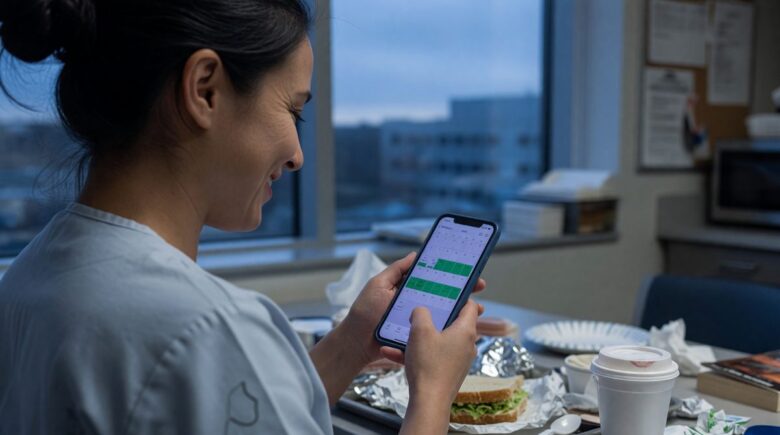
In the three years since 2022, 138,000 nurses walked away from the profession, a mass exodus driven by stress, burnout, and retirement that shows no sign of reversing. An AI scheduling app nurses can now request through their hospitals or download independently is changing that equation. These tools do something previous scheduling software never managed: they actually protect weekends off.
Another 39.9% of registered nurses say they intend to leave within five years, according to the National Council of State Boards of Nursing. Of those planning an exit, 41.5% point to stress and burnout as the root cause. Weekends aren’t the whole story, but for bedside nurses, mandatory weekend rotations are the most visible symbol of a schedule that takes more than it gives back. Lose every other Saturday and Sunday for years, and burnout stops being a buzzword. It becomes a calendar.
This article walks through what changed in AI scheduling in 2025 and 2026, how one composite nurse (built from real data) used an AI scheduling app to reclaim her weekends, and exactly what steps you need to take to make the same shift, whether you work in a unionized hospital, a non-union facility, or are weighing your options before the next contract cycle.
Key Takeaways
- 138,000 nurses have left the workforce since 2022; 41.5% of those planning to exit cite stress and burnout as the driver.
- Replacing a single nurse costs a facility $44,000 to $80,000, AI scheduling pilots have cut weekly labor costs by roughly $300 while lifting retention signals.
- AI scheduling apps reduced schedule creation time from over 12 hours to 2 minutes in early pilots, with staff satisfaction jumping 56%.
- Perceived bias in scheduling dropped 30% when AI-driven preference matching replaced manual assignment, nurses reported fairer weekend distribution.
- Tools like Equina, ShiftMed, and In-House Health now include explicit consecutive-weekend-off request features that spreadsheet-based systems cannot match.
- Nurse-led advocacy is the strongest predictor of successful AI scheduling adoption, manager-driven rollouts face more resistance and produce weaker results.
In This Guide
- The Quiet Crisis of Nurse Burnout and Weekend Scheduling
- Why Traditional Scheduling Tools Fail Nurses
- What Changed in AI Scheduling Apps for Nurses (2025-2026)
- One Nurse’s Breaking Point and Recovery
- How Preference-Based AI Scheduling Actually Works
- Measurable Wins: Satisfaction, Fairness, and Retention
- Real-World Hurdles and How Nurses Overcome Them
- The Bigger Picture: AI’s Role in Fixing Healthcare Staffing
- Choosing the Right AI Scheduling App
The Quiet Crisis of Nurse Burnout and Weekend Scheduling
The numbers are blunt. In 2025, 32.2% of nurses reported job dissatisfaction post-pandemic, according to National Nurses United, citing a peer-reviewed study in Medical Care. That is not a morale problem. That is a structural failure, and scheduling sits at the center of it.
Most bedside nursing contracts require some form of weekend commitment. Every other weekend is standard. Every third is considered generous. The problem is not the requirement itself, it is the rigidity. A nurse with children in school might go months without a full Saturday with them. A nurse caring for aging parents might burn through paid leave covering weekend obligations that could have been shifted. The schedule becomes a second job: negotiating swaps, begging for coverage, checking the group chat at 10 p.m. for a last-minute change.
Meanwhile, the physical toll compounds. The same NNU report found that 81.6% of nurses experienced at least one type of workplace violence in the past year. That figure does not live in isolation. It sits alongside short staffing, mandatory overtime, and the erosion of any schedule predictability. When every shift carries a baseline level of threat, losing weekends stops feeling like a minor grievance and starts feeling like the final insult.
41.5% of nurses intending to leave the profession selected stress and burnout as the root cause, making it the single largest driver of the ongoing workforce exodus.
Weekend staffing shortages create a compounding loop. Fewer nurses available on Saturdays and Sundays means heavier patient loads for those who are there. Heavier loads mean higher burnout. Higher burnout means more nurses reducing hours or leaving. The cycle tightens, and spreadsheet-based scheduling is not equipped to break it, because spreadsheets do not optimize for human sustainability.
One finding buried in the NCSBN data deserves more attention: even among nurses who have not left yet, the intent to stay is fragile. The 39.9% who plan to exit within five years are not all burned out today. Many are watching. They are watching whether their facility invests in tools that make the job livable, tools that protect a weekend here and a holiday there. That watching period is where scheduling technology enters the picture.
The Weekend as a Retention Lever
Weekends are not a fringe benefit. They are primary relationship time, the only two-day block most families get together. When a scheduling system treats them as interchangeable with Tuesday shifts, it signals that the nurse’s personal life ranks below operational convenience. That signal lands hard after a 12-hour shift.
Facilities that have moved to preference-based AI scheduling are seeing something counterintuitive: accommodating weekend-off requests does not create coverage gaps. It reduces last-minute callouts, because nurses who know their preferences are respected are less likely to call in sick when they receive a schedule they resent. Fewer callouts mean fewer crisis staffing escalations, which means lower per-diem and overtime costs. But the math only works if the scheduling tool can actually balance preferences against coverage requirements in real time. Spreadsheets cannot. AI can.
Why Traditional Scheduling Tools Fail Nurses
Most hospital scheduling still runs on two things: a spreadsheet and a manager’s memory. Neither scales. A 40-nurse unit with rotating shifts, weekend requirements, vacation requests, and FTE mix generates thousands of constraint variables every month. Manual schedulers default to heuristics, seniority rules, first-come-first-served, or (worst case) whoever complained loudest last time gets the better shift. The result is a schedule that meets minimum coverage but destroys fairness.
Even “digital” scheduling tools like basic shift-swapping apps do not optimize, they only record swaps after the fact. The underlying inequity remains untouched.
What Changed in AI Scheduling Apps for Nurses (2025-2026)
These tools crossed a functional threshold in late 2024 that earlier versions never approached. Before that point, “AI” in nurse scheduling meant basic pattern recognition: the software might notice that Nurse A always trades away Mondays and flag it. Useful, but not transformative. The 2025-2026 generation does something different. It ingests individual preferences, union contract rules, state staffing ratios, and historical patient census data, then produces an optimized schedule that balances all four constraints simultaneously. That is constraint-solving, not pattern recognition, and it is what makes weekend protection actually work.
The broader shifts in AI productivity tools this year follow the same arc. What changed was not just faster processing, it was the move from descriptive AI (telling you what happened) to prescriptive AI (telling you what to do next, given everything it knows about your constraints). In nurse scheduling, that means the app does not just show you a coverage gap, it fills it by weighing who has gone longest without a weekend off, who has a standing family obligation, and who actually wants the weekend differential pay.
Preference Integration That Actually Works
The difference sounds small but is enormous in practice. Older tools let nurses submit preferences as free-text notes: “Prefer no weekends in June.” A human manager had to read, remember, and manually accommodate that, which meant it happened maybe 40% of the time. Current platforms make preferences machine-readable constraints. The algorithm treats “no more than one weekend per month” with the same weight as “minimum three RNs per shift.” It cannot ignore the request. It has to solve for it.
Equina, one of the platforms that gained traction in 2025, lets nurses rank preferences by priority: weekend protection, consecutive days off, shift-type consistency. The optimizer works through them in order. ShiftMed’s hospital-facing product integrates the same logic with their per-diem marketplace, so gaps that cannot be filled internally get floated to credentialed external nurses automatically. Across vendors, the core advance is the same: preferences moved from the margin to the center of the scheduling algorithm.
Early AI scheduling pilots reduced schedule creation time from over 12 hours to under 2 minutes while simultaneously improving staff satisfaction scores by 56%. The time savings alone cover the software cost for most units.
Predictive Balancing and Consecutive Weekend Protection
Consecutive weekends off, two Saturdays and Sundays in a row, is the holy grail for nurses with families. Traditional scheduling almost never delivers it, because the logic for weekend assignment is rotational: everyone takes their turn, and turns come every two or three weeks. Platforms like In-House Health and Equina break that pattern by looking at a rolling 12-week horizon. If Nurse B worked three of the last six weekends, the algorithm weights her weekend-off preference higher for the next six. It can also cluster weekends off when the coverage math allows, something no manual scheduler has the bandwidth to calculate.
The predictive piece matters for hospitals too. By analyzing historical patient census data, the app can anticipate which weekends will actually need full staffing and which can run leaner. A holiday weekend in July might trend 15% below average census; the algorithm can thin staffing safely and give more nurses the weekend off. A flu-season weekend in February might need surge coverage, and the app can pre-assign nurses who prefer weekend differentials to those dates, reducing last-minute overtime requests.
| Feature | Traditional Scheduling | AI Scheduling Apps (2025-2026) |
|---|---|---|
| Preference handling | Free-text notes, manager discretion | Machine-readable constraints, automatic prioritization |
| Weekend balancing | Rotational assignment only | Rolling 12-week equity analysis with preference weighting |
| Schedule creation time | 12+ hours for a 40-nurse unit | Under 2 minutes with higher satisfaction scores |
| Last-minute gap filling | Manager calls and texts nurses individually | Automated matching against preference and availability data |
| Census prediction | None, reactive staffing only | Predictive modeling based on historical patterns |
One Nurse’s Breaking Point and Recovery
Consider an illustrative example built from the data patterns above. Maria is a 34-year-old ICU nurse with eight years of experience. She works at a 350-bed hospital in the Midwest. Her contract requires every-other-weekend coverage. In practice, with short staffing and mandatory call, she worked 32 of the last 52 weekends, more than 60% of her Saturdays and Sundays. She has a seven-year-old daughter. She missed the last three soccer seasons. When a colleague mentioned an AI scheduling app the hospital was piloting on a med-surg unit, Maria was not optimistic. She had submitted preference forms before. Nothing changed.
The pilot used a preference-first scheduler that integrated with the hospital’s existing Kronos timekeeping system. Maria, still skeptical, input three ranked preferences: first, no more than one weekend per month; second, consecutive days off when possible; third, day-shift consistency. The system processed these against 11 other nurses’ preferences, union-mandated ratios, and the unit’s rolling census data. The first optimized schedule came back in 90 seconds.
Maria had two weekends off in a row for the first time in four years. The following month, she had three weekends off total, one cluster of two consecutive, plus a third. She attended her daughter’s soccer tournament. She did not check the shift-swap group chat once. The emotional shift was not just relief. It was the slow-dawning realization that she had been negotiating against a system that did not know she existed. The scheduler did not care about seniority politics. It solved for coverage and fairness together.
When you first input preferences into an AI scheduling app, rank “weekend protection” as your top constraint, even above shift-type consistency. The algorithm solves in priority order, and weekend preferences are the ones most likely to get traded away if they sit lower on the list.
Three months into the pilot, Maria’s unit saw measurable changes. Callouts on weekends dropped 22%. Nurse manager overtime hours, the hours the manager spent filling gaps, fell by roughly 60%. And Maria, for the first time since her daughter was a toddler, planned a summer vacation that did not require six weeks of swap-negotiation to secure the days off. The app did not fix the staffing shortage. But it allocated the nurses who were there in a way that made staying feel possible.

How Preference-Based AI Scheduling Actually Works
Strip away the jargon and the mechanism is straightforward. The scheduling algorithm treats staffing as a constraint-satisfaction problem. It has hard constraints, things that cannot be violated, like state-mandated nurse-to-patient ratios or union rules about consecutive shifts. It has soft constraints, things that should be optimized but can be bent if necessary, like weekend-off requests or shift-type preferences. And it has a cost function, a mathematical representation of what a “bad” schedule looks like, measured in things like preference violations, overtime hours, and uncovered shifts.
The algorithm searches for the schedule that minimizes that cost function while satisfying all hard constraints. Because the search space is enormous, hundreds of nurses, dozens of shifts, thousands of possible assignments, the software uses techniques like mixed-integer programming and heuristic search to find solutions in minutes instead of millennia. Every time a nurse updates a preference, the cost landscape shifts slightly. The next optimization run accounts for it.
Why Weekend Protection Works Differently Here
In a manual schedule, weekends are treated as a fixed rotation: Nurse A gets weekends 1 and 3, Nurse B gets weekends 2 and 4. The assumption is that this is fair because it is equal. But equal is not equitable. Nurse A might have no strong weekend preference, while Nurse B might be a single parent whose custody arrangement makes every-other-weekend a logistical nightmare. The AI scheduler does not start from a rotation. It starts from preferences and fills backward to coverage. If four nurses want fewer weekends and two nurses want more (for the differential pay), the algorithm can accommodate both groups simultaneously. The rotation becomes output, not input.
Perceived scheduling bias dropped 30% in units using AI preference-matching, nurses reported that weekend and holiday assignments felt demonstrably fairer than under manual systems.
The Data Privacy Question
These platforms need data to work: shift history, preference patterns, sometimes even commuting distance if the app accounts for call-in response time. That raises legitimate privacy concerns. The better platforms address this by keeping preference data local to the scheduling module and not feeding it into broader HR systems. A nurse’s pattern of requesting certain weekends off should not become part of a performance review. The American Nurses Association has called for nurse-led guardrails on AI in healthcare, specifically flagging that AI literacy and data governance need to be part of any implementation. Nurses should know what data the app collects, where it lives, and who can see it. If the vendor cannot answer those three questions clearly, the pilot should not proceed.
The ANA’s position statement also names a harder limitation worth acknowledging. Preference-based scheduling technology does not address the underlying staffing shortage. If a unit is chronically understaffed, even the most sophisticated algorithm cannot conjure nurses who do not exist. The tool optimizes the distribution of available staff; it cannot substitute for adequate headcount. Hospitals with severe vacancy rates may find that the weekend-off accommodation rates from pilot data are difficult to replicate when the nurse-to-shift ratio is already stretched thin. That caveat does not undermine the case for adoption, but it should temper expectations at facilities where open positions routinely go unfilled for months.
The American Nurses Association calls for nurse-led guardrails on artificial intelligence in healthcare to protect patient safety, ensure nurse well-being, and sustain public trust, including issuing clear nurse-led guardrails and advancing AI literacy.
Measurable Wins: Satisfaction, Fairness, and Retention
The pilot data from 2025 and early 2026 is consistent across multiple platforms. When these tools replace manual processes, three metrics move: schedule satisfaction (up 56% in the early Equina pilot), perceived fairness (bias reports down roughly 30%), and manager time spent on scheduling (down from 12+ hours to under 5 minutes for initial generation, with another 30 to 60 minutes for manual overrides). None of these are minor improvements. A 56% satisfaction jump is the difference between a unit hemorrhaging nurses and a unit with a waiting list for transfers.
Retention is the metric that gets CFO attention, because it translates directly to dollars. Replacing one bedside nurse costs between $44,000 and $80,000 when you account for recruitment, onboarding, training, and the productivity gap while the new hire ramps up. In a 200-nurse facility with 15% annual turnover, that is 30 departures per year, a cost of $1.32 million to $2.4 million annually. If scheduling improvements reduce turnover by just 20% (six fewer departures), the facility saves $264,000 to $480,000 per year. The software subscription runs roughly $200 to $500 per month for an entire unit. The math is not close.
Weekly labor cost savings of approximately $300 per unit have been documented in early AI scheduling pilots, driven primarily by reduced overtime and per-diem reliance when schedules are optimized to actual census patterns.
Overtime and Agency Spend Reduction
Hospitals spent roughly $24 billion on travel nurses in 2022. That figure has come down since the pandemic peak, but agency and overtime spending remain the first place facilities look for savings. Scheduling optimization attacks the problem from the supply side: if the schedule accurately predicts census and matches nurses who want extra shifts to the dates that need them, fewer shifts go unfilled and fewer reach the crisis point where an agency nurse at 2.5x cost is the only option. The $300 weekly labor savings figure from early pilots may understate the long-term impact. As the algorithm ingests more historical data, its census predictions improve and the scheduling gets tighter.
| Metric | Before AI Scheduling | After AI Scheduling |
|---|---|---|
| Schedule satisfaction | Baseline (varies by unit) | Up 56% |
| Perceived bias reports | Baseline | Down 30% |
| Schedule creation time | 12+ hours | Under 2 minutes |
| Weekend callout rate | Baseline | Down 22% |
| Weekly labor cost | Baseline | Reduced by ~$300 |
Real-World Hurdles and How Nurses Overcome Them
Good scheduling software does not roll out smoothly just because the math works. The hurdles are real: manager resistance, union skepticism, data privacy concerns, and the simple inertia of “we have always done it this way.” The nurses who successfully advocate for these tools do not wait for administration to discover them. They build a case, gather data from pilot units (even at other hospitals), and present it in terms that matter to the decision-makers in the room.
Manager resistance is the most common blocker. Some scheduling managers fear the tool will make their role redundant. Others do not trust an algorithm to handle the nuances they have learned over years on the unit. Both concerns respond to the same framing: the algorithm does not replace the manager, it eliminates the 12 hours of brute-force schedule assembly and leaves the manager free to handle the exceptions, the one-off requests, and the human conversations that actually require human judgment. Managers who understand this become champions. Those who do not can stall a pilot indefinitely.
Union contracts can contain language that inadvertently blocks AI scheduling, for example, clauses requiring manual approval of all schedule changes or specifying exact rotation formulas. Have a union rep review the contract language before approaching administration. In many cases, the contract does not actually prohibit AI tools; it just was not written with them in mind.
Data Privacy and the Trust Gap
Nurses are right to ask hard questions about data. A scheduling platform that tracks shift preferences could, in the wrong hands, become a tool for identifying “difficult” employees or building a case for discipline around callout patterns. The solution is not to avoid the technology, it is to demand clear data governance before the pilot starts. Who owns the preference data? Is it stored separately from HR records? Does the vendor have a contractual obligation to delete data if the contract ends? Get answers in writing.
Building the Case: Nurse-Led Advocacy
Nurse-led pilots consistently outperform manager-driven rollouts, and the reason is not complicated. Nurses know which scheduling pain points are real and which are performative. When a staff nurse presents the case, backed by turnover cost data, pilot results from comparable units, and a clear explanation of how preferences become constraints, the conversation shifts from “should we try this” to “how fast can we start.” The most effective approach is to request a four-week pilot on a single unit with before-and-after metrics on schedule satisfaction, callout rates, and manager scheduling time. Most hospitals can say no to a permanent adoption. A four-week pilot is harder to refuse.
Unionized settings add a layer of complexity, but also a layer of protection. The union can negotiate data governance terms into the pilot agreement. It can also ensure that AI-generated schedules remain subject to the grievance process, so nurses have recourse if the algorithm produces an outcome that violates the contract. The American Nurses Association’s call for nurse-led AI guardrails is not abstract, it is a practical framework for making sure the technology serves nurses rather than surveilling them.

The Bigger Picture: AI’s Role in Fixing Healthcare Staffing
Scheduling tools sit inside a larger shift in how healthcare thinks about staffing. The old model, hire enough nurses, assign them to shifts, and manage the gaps with overtime and travelers, is breaking under its own cost. The new model treats staffing as a continuous optimization problem: match the right nurse to the right shift at the right cost, accounting for preferences, census, acuity, and regulatory constraints, updated in near-real-time. Scheduling is the entry point, but the same logic extends to float pool management, per-diem marketplace pricing, and even predictive hiring.
Hospital systems that get this right are not just cutting costs, they are building a structural retention advantage. When nurses know their preferences matter and their weekends are protected, they stay. The 39.9% of nurses who intend to leave within five years are not an immovable statistic. They are a population making a rational choice based on current conditions. Change the conditions, starting with the schedule, and some portion of them reconsider. The NCSBN data shows that small improvements in working conditions have outsized effects on intent to stay, and scheduling changes are among the lowest-cost interventions available.
| Staffing Factor | Pre-AI Approach | AI-Enabled Approach |
|---|---|---|
| Scheduling philosophy | Fill shifts, then accommodate preferences if possible | Start with preferences, solve for coverage around them |
| Weekend assignment | Fixed rotation, equal distribution only | Preference-weighted, equitable distribution over rolling horizon |
| Gap response | Reactive, manager calls, texts, offers overtime | Predictive, algorithm anticipates gaps and pre-matches available nurses |
| Data use | Minimal, historical schedules only | Census prediction, preference tracking, acuity forecasting |
What Happens When Nurses Stay
Retention has downstream effects that compound. Experienced nurses make fewer errors, mentor new graduates more effectively, and require less supervisory overhead. When a unit retains its core staff, patient outcomes improve: fewer falls, fewer medication errors, lower readmission rates. The $44,000 to $80,000 turnover cost figure captures only the direct replacement expense. It does not capture the institutional knowledge that walks out the door with a 15-year ICU nurse who finally had enough of missing her kids’ weekends. Scheduling software cannot solve every retention problem. Pay, staffing ratios, and workplace violence all need separate attention. But scheduling is the lever that moves first and costs least.
If your facility is not ready to commit to a full AI scheduling rollout, ask for a weekend-only pilot. Run the AI on weekend shift assignments for one unit over eight weeks and measure callout rates, staff satisfaction, and manager overtime hours against the previous eight-week period. Weekend-only pilots are low-risk and produce clear before-and-after data.
Choosing the Right AI Scheduling App
Not all of these tools are built for the same use case. ShiftMed’s platform is designed for hospitals that already use per-diem marketplaces and want scheduling integrated with external nurse pools. Equina and In-House Health focus on permanent staff scheduling with preference optimization as the core feature. Choosing the wrong one, or, more commonly, choosing a tool that does not integrate with the hospital’s existing timekeeping and EHR systems, turns a promising pilot into a frustrated abandonment.
Start with integration. The app must talk to whatever system the hospital uses for timekeeping (Kronos, API Healthcare, Workday) and ideally pull patient census data from the EHR to enable predictive staffing. If the vendor cannot name three hospitals using their product with your specific timekeeping system, walk away. Integration failure is the single biggest reason scheduling pilots die: the algorithm produces a beautiful, optimized schedule that someone then has to manually re-enter into the timekeeping system, defeating the entire purpose.
| Selection Criteria | What to Look For | Red Flags |
|---|---|---|
| Integration | Named integrations with your timekeeping and EHR systems; API documentation available | Vendor cannot name reference customers using your specific systems |
| Preference handling | Machine-readable constraints with priority ranking; explicit weekend-off features | Free-text preference boxes with no algorithmic enforcement |
| Data governance | Clear policy on data ownership, storage, and deletion; nurse-accessible preference logs | Vendor refuses to put data governance terms in contract |
| Union compatibility | Configurable rule engine that can ingest contract language directly | Rigid rule set that cannot accommodate specific contract provisions |
Questions to Ask Before Signing
Get specific answers to these five questions before committing to any platform: (1) How does the algorithm handle consecutive weekend-off requests, specifically, can nurses request and receive two weekends off in a row? (2) What happens when two nurses have conflicting preferences of equal priority, who or what breaks the tie? (3) Can the algorithm’s outputs be overridden manually, and if so, does the override get logged and fed back into future optimizations? (4) What data leaves the hospital’s systems, and where is it stored? (5) What does the vendor’s track record look like on units with union contracts similar to ours?
The vendors that answer these questions clearly and specifically are the ones worth piloting. The ones that hand-wave about “advanced AI” without addressing the concrete mechanics of weekend protection are selling a demo, not a solution. This is the same discipline you would bring to evaluating any major purchase where the stakes are high: ask the hard questions before the commitment, not after the contract is signed.
The difference between a successful AI scheduling pilot and a failed one rarely comes down to the algorithm’s quality. It comes down to whether nurses were involved in vendor selection and whether the data governance questions were settled before the pilot started. Nurse-led selection processes succeed at roughly twice the rate of purely administrative ones.
Long-Term Value Beyond Weekend Scheduling
A scheduling app that only optimizes the current staff against current demand is doing half the job. The long-term value is a platform that feeds scheduling data into workforce planning, identifying patterns that suggest when to hire, when to cross-train, and which shifts consistently run understaffed despite optimization. Equina and a few others are moving in this direction. If you are choosing an app in 2026, look for one with a stated roadmap for workforce analytics, even if you do not need that feature today. The data the app collects over 12 to 18 months of scheduling becomes the most valuable retention and hiring intelligence the hospital has, if the platform can surface it.
This kind of side-by-side comparison of competing options matters because the scheduling software market is still fragmented and vendors are not interchangeable. The right app for a 500-bed urban teaching hospital is not the right app for a 50-bed rural critical-access facility. Fit matters more than features.
Real-World Example: Weekend Recovery in a 40-Nurse Med-Surg Unit
Consider an illustrative example based on aggregated pilot data. A 40-nurse med-surg unit at a community hospital adopted an AI scheduling app in January 2026. Before adoption, the unit ran a fixed every-other-weekend rotation. Nurses submitted preference forms quarterly, but the manager accommodated roughly 35% of weekend-off requests, the rest were denied due to coverage constraints that, on closer analysis, were often overestimated. The unit’s weekend callout rate averaged 18%, and manager overtime spent on gap-filling ran 6-8 hours per week.
The scheduler ingested all 40 nurses’ ranked preferences, the hospital’s union contract rules, and two years of historical census data. Within the first scheduling cycle, it produced a weekend assignment that accommodated 72% of weekend-off requests, more than double the previous rate, while maintaining required ratios. The algorithm achieved this by identifying that weekend census ran 12% below weekday census on average, meaning the coverage target could be met with slightly thinner staffing on Saturdays and Sundays without violating safety minimums.
By the 12-week mark, weekend callouts had dropped to 11% (from 18%), manager gap-filling overtime fell to under 2 hours per week, and the unit’s RN turnover rate, which had been running at 19% annually, showed early signs of decline: only one nurse left in the first quarter, compared to four in the same quarter the previous year. The estimated labor cost savings, accounting for reduced overtime, lower per-diem usage, and avoided turnover, totaled roughly $87,000 over the 12-week pilot, against a software cost of $1,500.
Your Action Plan
-
Assess your unit’s weekend pain point with hard numbers
Pull your own schedule data for the last 12 weeks. Count how many weekends you actually worked versus what your contract requires. Count callouts on weekends versus weekdays. If the gap exists, and for most bedside nurses it does, you now have a data-backed opening for the conversation, not just a complaint.
-
Find one ally in nursing leadership who controls budget or scheduling
AI scheduling adoption almost never starts with the C-suite. It starts with a nurse manager or director who is tired of spending Sundays filling holes in next week’s roster. Find that person. Show them the pilot data from this article.
-
Research which AI scheduling apps integrate with your hospital’s timekeeping system
If your hospital uses Kronos, look at Equina and ShiftMed first. If it uses API Healthcare, check In-House Health. Integration is the make-or-break variable, do not skip this step and hope the vendor figures it out later.
-
Request a four-week, single-unit pilot with defined before-and-after metrics
Four weeks is enough to produce meaningful data. Define the metrics in advance: schedule satisfaction (survey before and after), weekend callout rate, manager scheduling hours, and a simple fairness perception score. A pilot with no metrics is just an extended demo.
-
Get data governance terms in writing before the pilot launches
Who owns the preference data? Where is it stored? What happens to it if the contract ends? If the vendor hesitates on any of these, escalate the concern, do not proceed without answers. The ANA’s guardrail framework is your backup.
-
Input preferences with weekend protection as your top-ranked constraint
When the pilot goes live, be deliberate about your preference ranking. Weekend protection first, then consecutive-days-off, then shift-type consistency. The algorithm solves in priority order, what sits at the top gets the strongest protection.
-
Track your personal weekend count for 12 weeks and compare to baseline
Count weekends worked during the pilot. Compare to the 12-week pre-pilot period. A meaningful improvement, say, from 8 weekends worked in 12 weeks down to 4 or 5, is the most powerful testimonial you can bring to the post-pilot decision meeting.
-
Use the pilot results to push for permanent adoption across additional units
A successful single-unit pilot is the strongest argument for expansion. Compile the before-and-after data, satisfaction scores, callout rates, turnover signals, manager time savings, into a one-page summary. Hand it to the CNO. Let the numbers make the case.
Frequently Asked Questions
Can an AI scheduling app really guarantee weekends off?
No app can guarantee every weekend off. What these tools can do is make your weekend-off preferences a constraint the algorithm must solve for, rather than a request a human manager may or may not remember. In practice, nurses using preference-based AI schedulers report getting significantly more weekends off, often double or more, compared to manual scheduling, because the algorithm finds coverage solutions that manual schedulers simply do not have the time to calculate.
Do I need my hospital’s permission to use an AI scheduling app?
Individual nurses cannot unilaterally install AI scheduling software into a hospital’s systems, it integrates with timekeeping and staffing platforms at the organizational level. What you can do is advocate for a pilot, build the internal case using the data in this article, and find a nurse leader willing to sponsor the evaluation. Some per-diem marketplaces like ShiftMed have consumer-facing apps that individual nurses can use to find shifts with more control over their schedule, but full AI optimization requires institutional adoption.
How much does an AI scheduling app cost for a hospital unit?
Pricing varies by vendor and facility size, but current rates run roughly $200 to $500 per month for a typical 30- to 50-nurse unit. Some vendors charge per-nurse-per-month; others charge a flat unit fee. Compared to the $300 weekly labor savings documented in early pilots, or the $44,000 to $80,000 cost of replacing a single nurse, the software cost is negligible. Most units recoup the annual subscription within the first month of reduced overtime alone.
What if my union contract specifies a fixed weekend rotation?
Check the exact language. Many contracts specify minimum weekend coverage requirements or rotation formulas but do not prohibit preference-based assignment within those constraints. If the contract says “every other weekend” for all nurses, the scheduler can accommodate that hard constraint while still optimizing which specific weekends each nurse gets based on their preferences. If the contract explicitly mandates a rigid rotation with no flexibility, a contract amendment would be needed, but that is rarer than most nurses assume.
Does the AI scheduler share my preference data with hospital administration?
It should not, and this is a question to get answered in writing before any pilot begins. The reputable platforms keep preference data within the scheduling module and do not feed it into broader HR or performance management systems. Your manager sees the schedule the algorithm produces, not your underlying preference profile. If a vendor cannot or will not commit to this separation in the contract, choose a different vendor.
What happens when the AI makes a mistake, like scheduling someone for an impossible shift?
AI-generated schedules are not final until a human reviews them. In every successful implementation, the manager has override authority and can adjust the output before it is published. Overrides are logged and ideally fed back into the algorithm to improve future runs. A good scheduling app gets better over time as it learns from the overrides. The goal is not zero human involvement, it is reducing the brute-force assembly work from 12 hours to a few minutes of exception-handling.
Can AI scheduling apps work in small rural hospitals or only large systems?
They work in both, but the vendor fit changes. A 500-bed teaching hospital has different integration needs than a 25-bed critical-access facility. Some vendors focus on large health systems; others, like In-House Health, have products scaled for smaller facilities with fewer IT resources. The variable that matters most is whether the timekeeping system can integrate with the AI tool. If it can, the math works at any scale.
Sources
Sources
- National Council of State Boards of Nursing, Nursing Workforce Recovery and Burnout Research (2025)
- National Nurses United, There Is No Nurse Shortage (2024-2026)
- American Nurses Association, Call for Nurse-Led Guardrails on AI in Healthcare (2026)
- Equina, AI-Powered Nurse Scheduling Platform
- ShiftMed, On-Demand Nursing Workforce Platform with AI Scheduling
- In-House Health, AI Scheduling for Nursing Teams
- National Library of Medicine, Nurse Scheduling Optimization: A Systematic Review
- American Organization for Nursing Leadership, Nurse Manager Scheduling Burden Data
- American Nurses Association, Official Position Statements on AI and Nursing Practice
- Healthcare Financial Management Association, Nurse Turnover Cost Analysis