Fact-checked by the YoureNewsSource editorial team
Quick Answer
As of July 2025, the best AI nutrition apps for diabetes use machine learning to personalize meal plans, track glycemic load, and predict blood sugar responses. Apps like Klinio, January AI, and Lark have shown users achieve up to 1.2% reductions in HbA1c within 90 days. They do not replace medical care but meaningfully support dietary self-management.
AI nutrition apps diabetes management tools represent one of the fastest-growing segments in digital health, blending continuous glucose data with machine learning to give people with Type 2 diabetes actionable, personalized dietary guidance. According to CDC diabetes statistics, over 38 million Americans currently live with diabetes, creating enormous demand for scalable nutrition support beyond quarterly clinic visits.
The stakes are high. Poor dietary management is the primary driver of Type 2 complications, and most patients see a registered dietitian fewer than three times per year. AI-powered tools are filling that gap in real time.
How Do AI Nutrition Apps for Diabetes Actually Work?
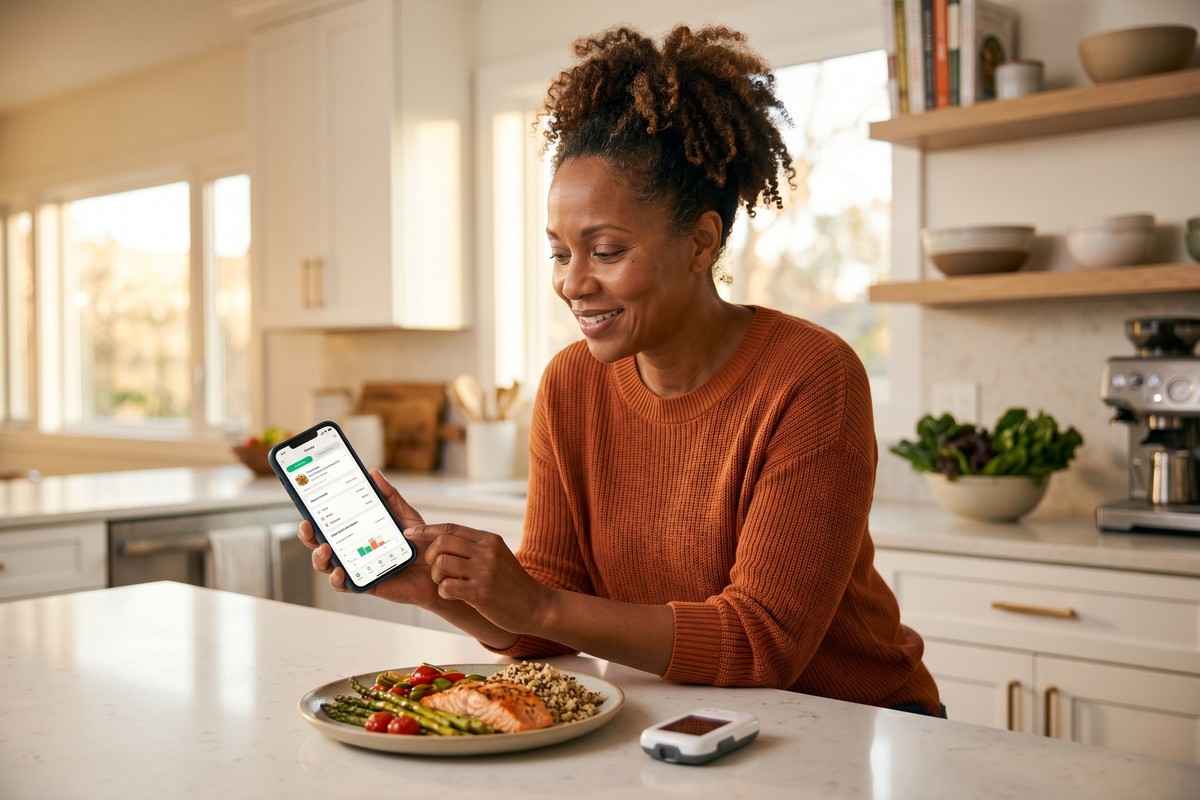
These apps combine food logging, glycemic index databases, and predictive algorithms to model how specific meals will affect an individual’s blood sugar — before the person eats. The core engine is a machine learning model trained on large datasets of continuous glucose monitor (CGM) readings paired with dietary intake logs.
When a user logs a meal, the app cross-references the food’s glycemic index, the user’s historical glucose response patterns, time of day, and recent activity levels. Research published in Nutrients (2022) found that personalized AI-driven meal recommendations reduced post-meal glucose spikes by up to 29% compared to standard dietary guidelines alone.
CGM Integration and Feedback Loops
The most capable platforms, including January AI and Nutrisense, sync directly with CGM devices such as the Dexcom G7 or Abbott FreeStyle Libre. This creates a closed feedback loop: the app sees how your glucose responded to last night’s dinner and recalibrates tomorrow’s recommendations accordingly.
Simpler apps like Klinio and MySugr rely on manual logging but still apply population-level glycemic models. They are less precise but significantly more accessible, requiring no CGM hardware.
Key Takeaway: AI nutrition apps for diabetes use machine learning trained on CGM data to predict personal glucose responses. Apps with direct CGM integration, like January AI, reduce post-meal spikes by up to 29% compared to generic dietary guidelines.
Which AI Nutrition Apps Are Best for Type 2 Diabetes in 2025?
The leading apps differ sharply in methodology, cost, and clinical validation. Choosing the right one depends on whether you use a CGM, your comfort with technology, and your primary goal — weight loss, HbA1c reduction, or general glucose stability.
Lark Health stands apart because it is the only AI nutrition and coaching app with FDA Breakthrough Device Designation for diabetes prevention and has been deployed by major insurers including UnitedHealth Group and Anthem. Its conversational AI coach delivers personalized meal feedback via text-style chat 24/7.
For people interested in how AI is reshaping health and productivity tools more broadly, the latest shifts in AI productivity tools offer useful context on how this technology is maturing across domains.
| App | CGM Integration | Monthly Cost | Clinical Evidence | Best For |
|---|---|---|---|---|
| January AI | Yes (Dexcom, Libre) | $29/mo | Peer-reviewed pilot study | Glucose prediction accuracy |
| Lark Health | No | Insurer-covered | FDA Breakthrough Device | Insured patients, coaching |
| Klinio | No | $16/mo | Internal user data | Budget-conscious users |
| Nutrisense | Yes (Abbott Libre) | $199/mo (with CGM) | Registered dietitian review | Deep glucose analytics |
| MySugr | Yes (select devices) | Free / $2.99/mo Pro | Roche-sponsored studies | Logging + medication tracking |
Key Takeaway: Among AI nutrition apps diabetes patients can access today, Lark Health is the only option with FDA Breakthrough Device Designation, making it the strongest choice for clinically validated support — and it is covered by over 50 major U.S. health plans at no out-of-pocket cost.
What Does the Clinical Evidence Say About Effectiveness?
The evidence base is growing but still maturing. Short-term studies show meaningful HbA1c and glucose improvements; long-term randomized controlled trial data remains limited. That said, results from existing trials are encouraging enough that American Diabetes Association (ADA) now explicitly recommends digital health tools in its 2024 Standards of Care in Diabetes.
A 2023 study in JMIR mHealth and uHealth followed 312 adults with Type 2 diabetes using an AI-guided nutrition app for 12 weeks. Participants saw an average HbA1c drop of 0.8 percentage points — a clinically meaningful reduction comparable to adding a second oral medication, without the side effects.
“Personalized, algorithm-driven nutrition guidance has the potential to deliver outcomes we previously only saw with intensive one-on-one dietitian programs — but at a fraction of the cost and at infinite scale.”
The limitations are real. Most studies are industry-funded, have high dropout rates, and rely on self-reported food logs — a notoriously inaccurate data source. Barcode scanning and AI photo recognition (used by apps like Lose It! and Cara Care) are reducing this problem, but calorie estimation from photos still carries a margin of error of roughly 20% according to NIH-published accuracy benchmarks.
Key Takeaway: Clinical trials show AI nutrition apps for diabetes can reduce HbA1c by an average of 0.8 percentage points over 12 weeks, a result endorsed by the ADA’s 2024 Standards of Care — though most evidence is short-term and partly industry-funded.
Are AI Nutrition Apps for Diabetes Safe and Regulated?
Regulatory oversight for AI nutrition apps is a genuine concern. Most apps in this category are classified as wellness software, not medical devices, meaning they fall outside the FDA’s rigorous premarket approval pathway. This creates a significant accountability gap.
Under the FDA’s Digital Health Center of Excellence framework, an app that claims to “diagnose” or “treat” diabetes is a medical device subject to regulation. But an app that “helps users make informed food choices” is not — even if it uses CGM data to predict glucose responses. Many vendors deliberately word their marketing to stay below this threshold.
Data Privacy Under HIPAA and State Law
Health data collected by apps outside a clinical setting is generally not protected by HIPAA unless the app is offered through a covered health plan or provider. The Federal Trade Commission (FTC) has begun enforcement actions under its Health Breach Notification Rule, but coverage remains incomplete. California’s CCPA and CMIA offer stronger protections for state residents.
Before committing to any platform, review its data-sharing policy carefully. Several apps, including some using the Google Health ecosystem, retain rights to use anonymized data for model training and third-party partnerships.
Key Takeaway: Most AI nutrition apps are classified as wellness software, not FDA-regulated medical devices, meaning your glucose and dietary data may not be HIPAA-protected. The FTC’s Health Breach Notification Rule offers some protection, but users should read privacy policies carefully before sharing CGM or biometric data.
How Should Someone With Type 2 Diabetes Choose an AI Nutrition App?
The right app depends on five practical factors: CGM ownership, budget, clinical goals, insurance coverage, and comfort with technology. There is no single best answer, but there is a clear decision framework.
Start with what your endocrinologist or registered dietitian already uses or recommends. Apps integrated into established electronic health record (EHR) systems — like those connected to Epic or Cerner platforms — allow your care team to see your logs, creating genuine clinical continuity. Standalone apps that operate in a silo offer convenience but lose the collaborative benefit.
Cost matters enormously. MySugr offers a robust free tier. Lark is often fully covered by employer health plans. Nutrisense costs nearly $2,400 per year with CGM hardware — a significant out-of-pocket expense for most patients. Look for apps that offer a 14-day free trial before committing, as individual glucose response variability means an app that works brilliantly for one person may underperform for another.
If you are managing other aspects of your financial health alongside a chronic condition — including decisions like building an investment cushion with limited funds — the cost-benefit calculus of premium health subscriptions becomes part of a broader financial picture worth considering.
Key Takeaway: Selecting the best AI nutrition apps for diabetes starts with insurance coverage — Lark Health is covered by 50+ U.S. health plans at no cost. For CGM users willing to spend more, Nutrisense delivers the deepest glucose analytics, but at nearly $2,400 per year with hardware included.
Frequently Asked Questions
Can an AI nutrition app replace my diabetes dietitian?
No. AI nutrition apps are decision-support tools, not licensed clinical providers. They can track meals, predict glucose responses, and suggest alternatives, but they cannot diagnose complications, adjust medications, or replace the individualized assessment a registered dietitian provides. Use them as a complement to — not a replacement for — your care team.
Which AI nutrition app is best for Type 2 diabetes without a CGM?
Lark Health and Klinio are the strongest options for users without a continuous glucose monitor. Lark’s AI coach uses conversational check-ins and food logging to deliver personalized guidance. Klinio offers structured meal plans calibrated to glycemic load. Both are accessible on a standard smartphone with no additional hardware.
Do AI nutrition apps for diabetes actually lower HbA1c?
Yes, with caveats. Peer-reviewed studies show average HbA1c reductions of 0.4 to 1.2 percentage points over 12 weeks with consistent app use. Results vary based on adherence, baseline HbA1c, and whether the app integrates with CGM data. They are most effective when used alongside medical supervision and lifestyle changes.
Are diabetes nutrition apps covered by health insurance?
Some are. Lark Health is covered by over 50 major U.S. health plans including UnitedHealth and Anthem. Medicare Advantage plans increasingly cover digital diabetes prevention programs certified by the CDC. Check your plan’s digital health benefits or ask your insurer directly about diabetes management app coverage.
Is it safe to share my glucose data with an AI nutrition app?
It depends on the app. Data shared outside a clinical relationship is generally not HIPAA-protected. Read the app’s privacy policy to understand whether your CGM or biometric data is sold, shared with advertisers, or used to train third-party AI models. Apps offered through your health plan carry stronger legal protections than direct-to-consumer products.
How accurate are AI food recognition features in diabetes apps?
Photo-based AI food recognition currently carries a calorie estimation error margin of roughly 15–20%, according to NIH-published benchmarks. Barcode scanning is significantly more accurate for packaged foods. For best results, use barcode scanning when available and verify restaurant meal estimates manually against the app’s nutrient database.
Sources
- CDC — National Diabetes Statistics Report
- American Diabetes Association — Standards of Care in Diabetes 2024
- NCBI/Nutrients — Personalized AI Meal Recommendations and Glucose Response (2022)
- NIH — Accuracy of AI-Based Food Photo Recognition for Calorie Estimation
- Federal Trade Commission — Health Privacy and the Health Breach Notification Rule
- FDA — Digital Health Center of Excellence
- JMIR mHealth and uHealth — AI-Guided Nutrition App RCT in Type 2 Diabetes (2023)