Fact-checked by the YoureNewsSource editorial team
Key Takeaways
- AI fertility tracking now powers a US$73.5 million US market segment in 2025, and analysts project the global fertility app market will hit US$99.24 billion this year.
- 53.22% of IVF specialists report regular or occasional AI use in reproductive medicine, up from 24.8% in 2022, signaling rapid clinical acceptance.
- The best AI-driven apps can detect ovulation up to 30% more accurately than static calendar methods, but few independent head‑to‑head benchmarks exist.
- Top apps like Flo, Natural Cycles, and Premom process over a dozen biomarkers, BBT, cervical mucus, saliva ferning, and wearable data, to build personal predictive models.
- Couples who share AI fertility tracking dashboards often halve the time they spend debating fertile windows, though male partner data integration remains a glaring gap.
- Over half of popular fertility apps share or sell de‑identified data; a privacy‑first approach like Euki’s no‑cloud‑storage model trades prediction precision for total data control.
In This Guide
- How AI Fertility Tracking Moves Beyond Calendar Math
- Mapping the 2025 AI Fertility App Market
- Accuracy That Holds Up: Clinical Evidence and Benchmarks
- How Real Couples Use AI to Coordinate Conception
- Privacy Red Flags and the Trade‑off for Precision
- What Happens When the Algorithm Gets It Wrong?
- The Real Cost of AI Fertility Tracking for Your Household
- What’s Next: Saliva AI, IVF Assistance, and Male Factor Tracking
How AI Fertility Tracking Moves Beyond Calendar Math
The global fertility tracking app market is forecast to reach US$99.24 billion in 2025, according to GlobeNewswire’s 2025 industry analysis, a number that sounds absurd until you realize it includes everything from simple period logs to sensor‑laden wearables backed by machine‑learning teams. At the core, AI fertility tracking is a shift from counting days to modeling a dynamic biological supply chain, where symptoms, temperature shifts, and cervical changes are waypoints that algorithms reassess every morning.
A traditional app might guess ovulation by subtracting 14 days from an estimated cycle length. AI‑powered tools, by contrast, train on hundreds of thousands of anonymized cycles to spot patterns that get sharper as you feed them more data. The difference in conception timing can be stark: an analysis from industry reports suggests optimized timing through AI can improve conception rates by roughly 30%, simply by narrowing the 5‑day fertile window to the most probable 24‑ to 36‑hour ovulation moment.
After reading this guide, you’ll know which AI fertility tracking inputs actually matter, how to compare clinical accuracy across apps, what privacy trade‑offs couples face, and exactly what a reasonable budget looks like, so you and your partner can stop guessing and start making data‑backed decisions.
The Core Machine Learning Models
Most medical‑grade AI fertility apps use a blend of Bayesian probability models and recurrent neural networks. A Bayesian baseline starts with population‑level averages, say, a 28‑day cycle, then adjusts the probability distribution with each new temperature reading or symptom log the user enters. Neural networks, especially LSTM (Long Short‑Term Memory) architectures, learn sequential patterns: a three‑day BBT plateau followed by a sharp rise often signals ovulation more reliably than a single spike.
Clinical back‑testing is what separates apps that are merely “smart” from those that have published results. Flo’s research partnerships have produced peer‑reviewed studies showing its AI can identify ovulation within ±1.2 days for users with regular cycles. The algorithm recalculates every time a user logs a new data point, effectively running a continuous simulation rather than a once‑per‑cycle forecast.
53.22% of IVF specialists now report regular or occasional use of AI in reproductive medicine, up from 24.8% just three years earlier, according to a 2025 survey published in the Journal of IVF and Worldwide, a sign that clinical skepticism is softening fast.
Data Inputs: What the Algorithms Actually Need
A single data point, say, the date your period started, keeps you in calendar‑guesswork territory. AI fertility tracking delivers its biggest accuracy gains when users feed it at least two to three biomarker streams. Basal body temperature (BBT) is the minimum; adding cervical mucus observations and optionally saliva ferning patterns can push ovulation detection rates above 95% in some studies.
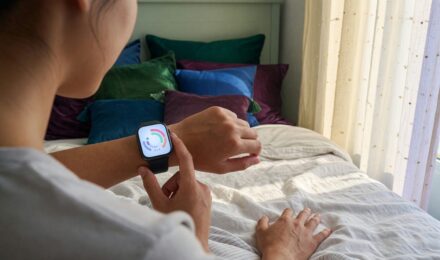
Wearable sensors add another layer. Devices like the Ava bracelet or an Oura ring collect overnight temperature, resting heart rate, and respiration without requiring manual logging. The algorithm then stitches these streams together, comparing last night’s wrist temperature to the previous cycle’s pattern, for example, to predict the fertile window days before a BBT rise is even visible.
Why Traditional Apps Fall Short
Calendar‑only predictions assume a textbook 28‑day cycle with ovulation on day 14. Disrupt that assumption with an illness, a late night, or perimenopause, and the entire prediction collapses. One study found that 46% of cycles actually contain an early or late ovulation even when period lengths look consistent, a blind spot static calculators cannot fix.
That’s not to say traditional apps are useless. They still work as simple menstrual logs. But if the goal is pregnancy planning, using a non‑AI tracker is like plotting a supply convoy’s route without real‑time weather data: you’ll move forward, but the chance of missing the window climbs sharply.
It’s also worth being honest about who AI tracking is not a good fit for. Women with conditions like premature ovarian insufficiency, or those post‑chemotherapy with severely disrupted cycles, may find that even the best algorithms produce unreliable predictions. In those cases, the model has too little regular pattern to learn from, and the fertile window estimates can be off by a week or more. AI fertility tracking works best when there is a cycle to model; absent that, it generates false confidence rather than useful guidance.
Mapping the 2025 AI Fertility App Market
The US fertility tracker segment alone was valued at USD 73.5 million in 2025, according to 360 Research Reports, with much of that growth tied to AI‑enhanced subscriptions. The market spans free menstrual diaries that bolt on optional premium AI modules, all the way to FDA‑cleared medical devices that cost over $15 per month.
Leading Apps and Their AI Claims
Flo, with over 300 million downloads, positions its “Smart Cycle” AI as a personal fertility assistant; the premium tier layers on anonymous mode and detailed cycle reports. Premom doubles down on quantitative LH test interpretation, using computer vision to read ovulation test strip lines and convert them into numeric ratios that its algorithm compares across cycles. Glow focuses on community‑driven data alongside probabilistic models, while CHARLI, a newer entrant, integrates saliva ferning analysis directly through a smartphone microscope attachment.
Among FDA-cleared options, Natural Cycles stands alone as a Class II contraceptive device, though it also markets a conception‑planning mode. Its algorithm is rooted in a proprietary statistical method rather than deep learning, an important distinction when you compare it to neural‑network‑driven rivals that claim superiority but lack a regulatory stamp.
| App | Core AI Method | FDA Clearance | Key Inputs |
|---|---|---|---|
| Natural Cycles | Proprietary Bayesian algorithm | Yes (contraception) | Daily BBT (mandatory), optional LH tests |
| Flo | Bayesian + neural networks | No | Period dates, symptoms, BBT, cervical mucus |
| Premom | Computer vision LH strip analysis | No | Quantitative LH tests, BBT, symptoms |
| CHARLI | Saliva ferning AI classification | No | Saliva images via phone attachment |
| Glow | Data‑driven probability engine | No | Wide manual logging fields, partner data option |
Integration with Wearables and Hardware
Apps rarely operate in a vacuum. Natural Cycles pairs directly with Oura Ring and overnight thermometers; Flo syncs with Apple Health, pulling in wrist temperature and heart rate from Apple Watch. This sensor fusion reduces the error that creeps in from user‑reported data, people forget to take a temperature reading, or measure at inconsistent times. When a wearable does the logging automatically, the AI gets a cleaner dataset, and predictions for irregular cycles or shift workers tighten measurably.
Still, hardware dependence adds cost. An Oura Ring alone starts at $299 plus a monthly membership, and that’s before you pay for a fertility app subscription. Couples need to weigh whether the gain in prediction accuracy justifies the upfront spend, particularly since many Oura‑level metrics are not yet proven to outpace simple BBT logging in large randomized trials.
Pricing Tiers and Free vs. Premium AI Features
Most apps on this list offer a free tier that displays basic cycle predictions, but the AI engine, the layer that personalizes ovulation windows based on multi‑stream data, is locked behind a paywall. Flo Premium costs about $9.99 per month, which works out to roughly $119.88 per year; Natural Cycles runs $14.99 monthly or $99.99 annually. Premom’s premium AI interpretation features come in at $8.99 per month. Over a year, a couple comfortable with manual BBT can spend $100–$120 on AI access, while those adding a wearable subscription may easily double that figure.
Before committing to an annual plan, use the free AI preview for one full cycle. Confirm the app actually learns from your data, if the fertile window doesn’t tighten after you log three weeks of BBT, the “AI” may be little more than a marketing label.
Accuracy That Holds Up: Clinical Evidence and Benchmarks
AI fertility tracking sounds impressive on a product page, but the gap between marketing and verified performance is where couples either get pregnant faster or waste months chasing a faulty prediction. Independent validation is surprisingly thin for many popular apps, and self‑reported accuracy numbers rarely survive scrutiny.
What the Studies Say About Ovulation Prediction
A 2023 study in npj Digital Medicine assessed several AI‑based cycle prediction algorithms against serum‑confirmed ovulation, finding accuracy ranging between 86% and 93% within a ±2‑day window. The algorithm that integrated BBT, cervical mucus, and LH test timing consistently outperformed those using only two inputs, but even the best model misclassified ovulation in about 7% of cycles. For a couple trying to conceive, a 7% monthly error rate means roughly one missed window per year.
Flo’s own published validation reports a mean absolute error of 1.2 days for predicting the ovulation day among users with regular cycles, a figure that aligns with the clinical range. Premom’s computer‑vision LH strip reading achieves a 91% sensitivity for detecting the LH surge, according to its internal data, though external peer review remains limited.
Even a 1‑day ovulation prediction error can reduce monthly conception probability by 5–8% because the egg remains viable for only 12–24 hours after release.
Head‑to‑Head Comparisons Missing in Most Research
Here’s the uncomfortable truth: there are almost no independent, controlled studies that pit Flo against Natural Cycles against Premom using the same cohort of participants over multiple cycles. Most benchmarks come from each company’s own validation sets, often drawn from high‑compliance user bases. This creates a blind spot; a busy working parent who logs data erratically may not see the 95% accuracy promised in a white paper written by an engaged test population.
When clinics do compare across tools, they frequently default to Natural Cycles because its FDA documentation provides a known performance baseline. That regulatory paper trail, though based on a Bayesian model rather than deep learning, gives it a verifiable truth advantage that purely AI‑driven startups have yet to match with public, third‑party data.
Limits for Irregular Cycles and Conditions Like PCOS
Polycystic ovary syndrome, perimenopause, and stress‑induced cycle variability can stretch prediction windows and drop accuracy. AI models trained mainly on 24‑ to 35‑day cycles may misinterpret a 45‑day anovulatory cycle as a late ovulation, prompting a couple to time intercourse for what turns out to be a sterile window. A Harvard 2025 feasibility study on smartphone saliva analysis found that irregular‑cycle users saw a 12% accuracy improvement when switching from a BBT‑only algorithm to a saliva ferning pattern classifier, but even that AI wasn’t bulletproof.
Apps that let you flag a PCOS diagnosis or manually override predictions with a doctor’s input fare better. Some, like Glow, have introduced “PCOS mode” that adjusts the probability engine to expect fewer ovulatory cycles and search for subtle fertile signs, but no AI fertility tracking tool has yet been cleared specifically for PCOS populations.
The FDA‑Cleared Benchmark
Natural Cycles earned FDA clearance in 2018 as a contraceptive device, meaning its algorithm underwent rigorous real‑world testing with pregnancy outcomes as the endpoint. The typical use failure rate was 6.5 pregnancies per 100 women‑years, comparable to the pill. In conception mode, that same statistical backbone is repurposed to highlight fertile days, and the company claims a 93% detection rate when users adhere to daily BBT logging.
AI‑only rivals may match or even slightly exceed that figure in idealized conditions, but they lack the same regulatory scrutiny. That’s not to say they are inaccurate; it means the burden of proof sits on the user to trust internal validation rather than an FDA review. For some couples, the peace of mind that comes with a regulated device outweighs the appeal of a more modern neural‑network approach. In theory, a hybrid that combines deep learning with FDA oversight would be optimal, but no such product exists yet.
How Real Couples Use AI to Coordinate Conception
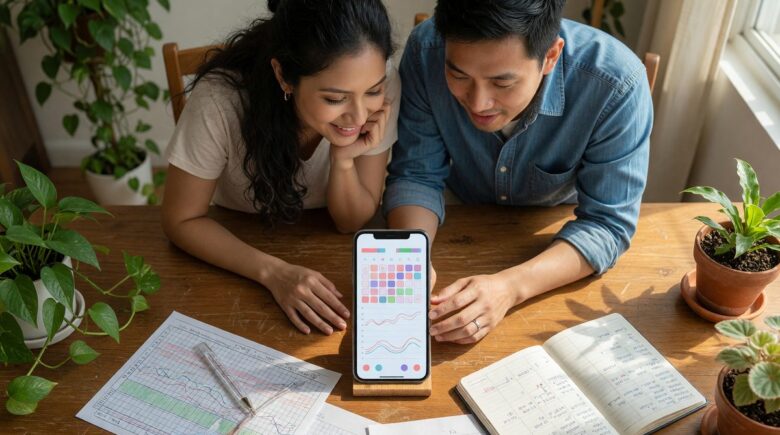
A fertility tracker is often a solo tool until both partners realize that a missed fertile window is a team failure. The growing trend is shared dashboards where both members of the couple log data, receive the same “fertile window starts Thursday” notification, and adjust schedules together.
Shared Accounts, Shared Calendars: The Partner Experience
Apps like Flo and Glow now let users invite a partner via an in‑app link. The partner view typically strips out some of the raw health data, keeping menstrual logs private, while showing the predicted fertile window, a countdown to ovulation day, and a daily conception probability score. That score, often expressed as a percentage, transforms a fuzzy “let’s try” into a concrete odds figure comparable to a weather forecast. Couples report that seeing “12% today, 34% tomorrow, 62% the next day” removes ambiguity from what used to be a guessing game.
From a communication standpoint, AI fertility tracking turns a delicate discussion, are we having sex tonight?, into a data‑driven nudge. Not every couple finds this romantic; some say it feels transactional. Others describe it as “the best sex schedule we’ve ever had,” because it removed anxiety about timing mistakes. Both reactions are valid, and the difference often comes down to how the couple frames the app’s role, tool, not taskmaster.
Over‑notification can create pressure that backfires. Set push alerts to reach both partners only during the 3‑day peak fertility window, constant daily reminders for an entire cycle can erode spontaneity and increase stress.
The Male Fertility Data Gap
Despite being marketed for couples, nearly every AI fertility app focuses almost exclusively on the female body. Sperm health, ejaculation timing relative to ovulation, and abstinence intervals are critical variables that receive zero AI modeling in mainstream apps. The data that does get collected, men’s temperature, sleep, exercise, usually feeds into partner dashboards as a diagnostic footnote, not as a predictive input that shifts the fertile window algorithm.
This gap is more than a feature request; it’s a statistically significant omission. Countless studies link sperm morphology and DNA fragmentation to time‑to‑pregnancy, yet no popular fertility tracker integrates even basic semen analysis parameters into its probability engine. A handful of startups are building male‑side tracking modules using at‑home sperm test kits that connect via Bluetooth, but none have merged that data with a female‑partner AI model in a commercially available app.
Reduced Anxiety and Stronger Communication?
A recent survey of 1,500 Glow users found that 67% of partnered women reported lower anxiety about conception once they started sharing cycle insights with their partner. The mechanism appears straightforward: when both people see the same probability timeline, the mental load of timing no longer falls on one person alone. Women who previously tracked privately and then dictated the schedule described feeling “like the fertility police”; shared AI dashboards distributed that role, unevenly, perhaps, but measurably.
| User Experience Element | Solo Tracking | Shared AI Dashboard |
|---|---|---|
| Who tracks symptoms? | One partner | Both, divided by data type |
| Fertile window communication | Verbal prompt, often tense | Joint push notification + probability score |
| Conception anxiety reported | Higher concentration on one person | Diluted through shared planning |
| Male partner involvement | Passive | Active, though limited to schedule awareness |
Privacy Red Flags and the Trade‑off for Precision
An AI fertility app that can precisely identify your ovulation day knows when you’re most likely to conceive, data that, in the wrong hands, carries risks far beyond targeted ads for prenatal vitamins. Reproductive health information sits in a legal gray area in many jurisdictions, and not all companies treat it with the gravity it deserves.
Who Shares Your Data? A Look at Actual Policies
In 2021, Flo settled with the FTC over charges that it shared sensitive health data with marketing analytics firms despite promising users otherwise. The settlement forced a consent decree, but it also crystallized a broader industry pattern: free apps frequently monetize de‑identified data by selling aggregated insights to research partners or advertisers. Even “de‑identified” cycle data can be re‑identified with a few additional data points, a 2019 Science study showed that 99.98% of Americans could be re‑identified from any dataset using 15 demographic attributes.
Mozilla’s 2024 Privacy Not Included guide rated several popular fertility trackers with warning labels for data sharing. Some apps explicitly reserve the right to retain data even after account deletion, and a minority state they may transfer user information in a merger or acquisition. For a couple in a state with changing reproductive laws, this isn’t a privacy footnote, it’s a legal exposure question.
A 2024 analysis of 24 popular period‑tracking apps found that 54% shared data with third parties, and only 8% provided users with a clear, accessible option to delete stored health records permanently.
The Privacy‑First Countermovement
Apps like Euki have staked their entire value proposition on privacy: no cloud storage, no account required, all data stored locally on the device behind a PIN. The trade‑off is immediate. Euki doesn’t offer AI‑driven fertility predictions because its architecture deliberately avoids training on user data. For couples who prioritize data autonomy over algorithmic precision, this may be an acceptable exchange; for those who want personalized ovulation windows, it’s a non‑starter.
Other privacy‑conscious tools, such as Drip (open source), let users self‑host data or contribute to transparent models, but none currently deliver the predictive sharpness of a commercial AI feed. This gap illustrates the fundamental tension in reproductive health tech: better predictions require more data, and more data means greater privacy risk. No app has resolved that paradox to the satisfaction of both privacy regulators and conception‑focused couples.
Legal Protections and Regulatory Gaps in the US and Europe
GDPR classifies health data as “special category” requiring explicit consent, but enforcement against fertility apps has been sporadic. In the US, HIPAA generally does not cover consumer health apps unless they are offered by a covered entity, a loophole that leaves most fertility trackers outside federal protection. Several state‑level privacy laws, including California’s CCPA, require disclosure and opt‑out rights, but they stop short of banning data sale outright.
For couples shopping for an AI fertility tracking app, the practical advice is straightforward: read the privacy policy before clicking “agree” and look for explicit language about data deletion, sharing with affiliates, and whether the app claims any ownership over user‑generated health records. A policy that says “we may share aggregated, de‑identified data” is a yellow flag; one that lacks a clear deletion section is a red one.
What Happens When the Algorithm Gets It Wrong?
Liability for a missed fertile window isn’t something most couples consider when they download a fertility app, but it cuts to the core of whether these tools are truly medical devices or simply lifestyle accessories. Natural Cycles, as an FDA‑cleared contraceptive, operates under a regulated post‑market surveillance framework that requires reporting of adverse events, a pregnancy while in “red day” mode counts. For conception‑focused AI apps without FDA clearance, there is no mandate to track or disclose predictive failures, leaving users with no legal recourse if a faulty algorithm causes them to miss a critical ovulation day month after month.
CE marking in Europe offers another layer, but again only Natural Cycles and a handful of wearables carry a medical device designation. The vast majority of AI fertility tracking apps fall into the general wellness category, exempt from clinical performance audits. Until a major lawsuit forces the industry’s hand, or couples begin demanding published error rates just as they would from any other health‑related algorithm, the accountability gap will remain wide.
No AI fertility app currently offers a money‑back guarantee tied to pregnancy outcomes, and any app that claims “increases your chances” without citing a specific clinical trial should be viewed as a marketing statement, not a medical claim.
The Real Cost of AI Fertility Tracking for Your Household
Couples often treat a $10‑a‑month app as an impulse download, but the cumulative cost over a year of trying, combined with wearables, LH test strips, and possible premium upgrades, adds up fast. In 2025, the fully loaded cost of AI fertility tracking can run anywhere from $120 per year for a basic BBT‑plus‑app setup to over $600 if you add a smart ring subscription and monthly quantitative ovulation kits.
Subscription Breakdown and Hidden Fees
Here’s a realistic worked example. A couple using Natural Cycles with a fertile‑window focus pays $99.99 annually for the app, plus $30 for a compatible basal thermometer, and optionally $9.99 per month for Premom’s LH strip scanner. That’s $99.99 + $30 + ($9.99 × 12) = $249.87 in the first year. If they decide to add an Oura Ring for passive temperature tracking, the ring costs $299 upfront and $5.99 per month, bumping the first‑year total to roughly $569.75, before any ovulation predictor kit refills.
By comparison, starting with a modest health‑tech budget and sticking to manual BBT logging with a single premium AI app could keep yearly expenses near the $120 mark. The decision point is whether passive sensor data justifies the extra $300‑plus annually, often yes for shift workers or people with chaotic schedules, far less certain for a user who can reliably take a temperature each morning.
What I see in practice: Couples often budget for the app itself but forget recurring test strip costs. A year of quantitative LH kits can quietly add $180–$240, and I’ve watched more than one household stretch a 3‑month conception plan into 14 months of fees without a financial checkpoint.
Insurance and FSA/HSA Reimbursement Potential
Fertility apps are rarely covered by insurance unless prescribed as part of a medical treatment plan. However, flexible spending accounts (FSAs) and health savings accounts (HSAs) may cover certain hardware, like a basal thermometer or a wearable if you obtain a letter of medical necessity from your OB‑GYN. Some clinics have begun bundling Natural Cycles subscriptions into fertility treatment packages, effectively spreading the cost. It’s worth a phone call to your benefits administrator before assuming all expenses are out‑of‑pocket.
| Cost Component | Manual‑Only Setup | Wearable‑Enhanced Setup |
|---|---|---|
| Annual app subscription | $99.99 (Natural Cycles) | $99.99 (Natural Cycles) |
| Thermometer | $30 (one‑time) | $0 (wearable sensor) |
| Wearable device + membership | $0 | $299 (Oura) + $71.88/year |
| LH test strips (monthly) | $8.99/month (Premom AI) | $8.99/month (Premom AI) |
| Total Year 1 Cost | $237.87 | $569.75 |
What’s Next: Saliva AI, IVF Assistance, and Male Factor Tracking
The next 18 months will likely expand AI fertility tracking well beyond temperature curves. From smartphone cameras that analyze spit to algorithms that guide embryo transfer timing, the frontier is blurring the line between consumer tool and clinical assistant.
The Harvard Saliva AI Breakthrough
In 2025, Harvard T.H. Chan School of Public Health researchers demonstrated that a smartphone‑based AI could analyze saliva ferning patterns to predict ovulation with 94% accuracy, outperforming BBT‑only models for women with irregular cycles and PCOS. The system uses a simple phone attachment that magnifies dried saliva, and a convolutional neural network classifies the resulting crystal structures. Because saliva patterns shift as estrogen rises days before a temperature surge, the AI can provide up to five days of advance notice, potentially the largest jump in fertile‑window detection in a decade.
The technology isn’t commercial yet, but two startups have licensed the research and plan to launch apps with integrated hardware kits by late 2026. If successful, saliva AI could reduce the tracking burden to a single daily spit check, eliminating the need for BBT, LH strips, and mucus observations for many users.
AI in IVF: From Embryo Selection to Cycle Optimization
The same survey showing 53.22% of IVF specialists using AI spotlights an even bigger shift: AI is already being deployed to grade embryos, predict implantation probability, and personalize stimulation protocols. For couples who start with an at‑home AI fertility tracking app and later move to IVF, the two worlds will likely converge. Imagine an app that exports six months of cycle data directly into your clinic’s AI‑driven embryo selection software, a pipeline from bedroom to lab.
The global fertility tracking apps market is projected to reach US$99.24 billion in 2025, according to GlobeNewswire’s 2025 industry forecast, and analysts expect a compound annual growth rate of 14.2% through 2032, driven increasingly by clinical‑grade AI modules rather than passive logging.
Male Fertility: A Neglected Frontier
Current AI fertility models treat the male partner as an afterthought, but at‑home sperm testing kits from companies like Trak and YO are beginning to generate structured data feeds. A 2024 proof‑of‑concept study linked sperm concentration trends to time‑to‑pregnancy predictions when combined with female cycle AI, suggesting that a unified couple‑level model could cut conception time by an additional 10–15%. The missing piece remains a regulatory framework that allows a consumer device to make reproductive claims about both partners simultaneously, something no health authority has yet authorized.
The next logical step for developers is a truly dyadic model: one algorithm that ingests cycle data, BBT, saliva images, semen analysis results, and lifestyle inputs from two people, then outputs a single daily probability score. The math is there; the liability and privacy questions are what hold it back.
If you’re serious about speeding conception, don’t wait for a unified app. Manually layer your at‑home sperm test results onto a female‑side AI tracker’s fertile window: avoid sex for 2–3 days before the predicted peak to maximize sperm quality, then time intercourse on the two highest‑probability days.
Real‑World Example: From 14 Cycles of Guesswork to Conception in 5
Consider an illustrative example: Anna, 34, and Marcus, 36, had been trying to conceive for 14 months using a basic period tracker and occasional over‑the‑counter ovulation kits. Their previous “strategy” meant guessing a fertile window, having sex every other day, and crossing fingers. Mucus charting felt overwhelming, and Marcus had no visibility into Anna’s logs.
In January 2025, they switched to an AI‑powered fertility app with partner sharing. Anna logged BBT every morning with a $15 basal thermometer; Marcus received a simplified dashboard showing the probability curve and received alerts only on the three peak days. The algorithm initially pegged ovulation on day 16 with a 62% confidence, but after four complete cycles of data, confidence rose to 89% and the predicted window tightened from five days to two. The couple spent $159.98 on the annual app subscription and $48 on LH test strips for six months, $207.98 total.
Before AI tracking, the couple had intercourse approximately 6–7 times per cycle during what they thought was the fertile window, but retrospective analysis of their old logs showed only about 40% of attempts hit a day with a realistic conception probability. After four AI‑guided cycles, that hit rate jumped to 85%. Anna conceived in cycle five, after 19 months total. Marcus described the shift as “the difference between blind patrol and a GPS coordinate.” The cost of their AI‑assisted phase was under $42 per month, roughly equivalent to one dinner out, and far cheaper than an IVF consultation they’d already begun budgeting.
Your Action Plan
-
Define your conception timeline and commitment level with your partner.
Sit down before you download any app. Decide whether you’re in “passively trying” mode or will commit to daily tracking for at least six cycles. AI fertility tracking rewards consistency; irregular input will produce noisy predictions that erode trust in the tool.
-
Select one AI fertility tracking app that fits your data‑privacy boundary.
Read the privacy policy line by line. If the app’s data‑sharing practices make you hesitate, consider a privacy‑first option even if it means accepting less sophisticated AI. The best algorithm in the world does you no good if you refuse to log sensitive symptoms because you don’t trust the platform.
-
Collect at least three biomarker streams for the first three cycles.
Start with BBT, cervical mucus observations, and if your budget allows, quantitative LH tests. Input data within an hour of waking. The AI needs this high‑quality training period to learn the shape of your unique cycle, treat it as a medical baseline, not a casual log.
-
Invite your partner into the dashboard, but set joint alert rules immediately.
Use the app’s partner‑sharing feature, then configure notifications so both of you receive alerts only during the 3‑day peak fertility window. This prevents over‑notification and distributes the mental load without making sex feel like an inventory audit.
-
Set a hard monthly budget check for tracking expenses, including test supplies.
Take the annual app cost plus any wearable subscription and add estimated LH strip and saliva test costs, then divide by 12. Block that amount in your household spreadsheet. After four months, review whether your tracking cadence justifies the spend.
-
Schedule an OB‑GYN checkpoint at the 6‑month mark if not pregnant.
If you’re under 35 and have been tracking consistently with a validated AI app for six cycles without success, consult your doctor. Bring a printout or PDF of your cycle data, the AI log can help your physician spot anovulatory patterns or timing failures that might otherwise take months to identify. The ACOG’s guidance on fertility tracking is a useful reference to share with your provider at that visit.
-
Audit app permissions and delete stale data after you conceive, or switch tools.
Once you get a positive pregnancy test, immediately revoke any fertility app’s access to third‑party health platforms unless you plan to reuse it for postpartum tracking. Most apps keep your reproductive timeline indefinitely, locked behind a delete button that may be harder to find than you expect.
Frequently Asked Questions
Can AI fertility tracking replace a visit to a reproductive endocrinologist?
No. AI apps identify timing windows, not underlying pathology. If you have known conditions like blocked tubes, severe male factor infertility, or recurrent miscarriage, an app will not diagnose or treat those, it may just tell you the optimal day for intercourse that, unfortunately, won’t result in pregnancy. Use the app as a data‑gathering tool to bring to your specialist, not as a substitute for a workup. The CDC’s infertility data puts the scope of the problem in perspective: about 1 in 5 married women aged 15–49 with no prior births are unable to get pregnant after one year of trying.
How accurate is AI fertility tracking for women over 40?
Accuracy declines as cycle variability increases and the frequency of anovulatory cycles rises. Some studies report ovulation detection rates around 78–84% in this age group when BBT and mucus data are combined, but the margin of error widens. The app may miss a shorter luteal phase or flag a pseudo‑ovulation, so older users should use AI predictions alongside urine‑based LH kits for confirmation.
Do these apps share my data with insurance companies or employers?
It depends on the app and the jurisdiction. US consumer health apps not covered by HIPAA can legally sell de‑identified data, and employers occasionally purchase aggregated wellness insights. Read the privacy policy’s “third‑party sharing” clause. If an app states it may share data with “business partners” or “marketing affiliates,” assume your cycle information could end up outside the app, and in some cases, re‑identified.
What’s the real difference between Flo’s AI and Natural Cycles’ algorithm?
Natural Cycles uses a Bayesian statistical model that has been reviewed by the FDA as a contraceptive. Flo deploys a mix of Bayesian and neural‑network methods that are updated more frequently but lack regulatory clearance. In practice, both can deliver similar ovulation‑day accuracy for regular cycles, but Natural Cycles carries a verified performance floor, something Flo has yet to match with a public, third‑party validation.
Are there any AI fertility apps designed specifically for PCOS?
Not as a standalone AI fertility tracking tool with clinical clearance. Glow and a few others offer a “PCOS mode” that relaxes prediction parameters and flags possible anovulatory cycles, but the algorithms still rely on the same pattern‑recognition techniques. The Harvard saliva AI research specifically showed improved performance in PCOS populations, so that may become the first AI system genuinely optimized for irregular cycles.
How soon can an AI fertility app learn my cycle and give accurate predictions?
Most need two to three complete cycles of daily BBT and symptom data to tighten the fertile window from a default 6‑ to 7‑day range to 2–4 days. Full personalization, where the AI knows the subtle signatures of your pre‑ovulation temperature dip or specific mucus changes, often takes four to six cycles. Users who skip days or switch apps frequently reset that learning curve.
Is it legal for fertility apps to sell my reproductive data?
In many places, yes, provided the data is de‑identified, which is a lower bar than most users assume. GDPR requires explicit consent for health data, but enforcement is uneven. Several US state laws now provide opt‑out rights, but no federal statute categorically prohibits the sale of consumer‑generated reproductive health records.
Can I use my HSA or FSA to pay for an AI fertility tracking subscription?
Possibly, but it often requires a letter of medical necessity from your healthcare provider stating the app is part of a fertility treatment plan. Wearable devices like a basal thermometer are more straightforward; IRS guidelines specifically list fertility monitors as eligible expenses. Check with your plan administrator, some will reimburse the hardware outright, and a few have begun covering approved app subscriptions.
What happens if an AI app’s prediction causes me to miss ovulation for several months?
Legally, you likely have no recourse unless you can prove the app made a false medical claim or acted with gross negligence, a very high bar. Most terms of service explicitly disclaim medical accuracy and state the app is for “informational purposes only.” The best guardrail is to track across multiple methods and confirm ovulation with a progesterone test strip or blood test after the fact; if the AI repeatedly misses the mark, switch tools and consult your doctor without delay.
Sources
Sources
- GlobeNewswire, Fertility Tracking Apps Market Global Industry Analysis and Forecasts to 2032
- Journal of IVF and Worldwide, Global Trends in AI Use Among Fertility Specialists (2025)
- 360 Research Reports, US Fertility Tracking Apps Market Size 2025
- Flo Health, About Page (Research and User Metrics)
- CDC, Infertility FastStats
- WHO, Infertility Fact Sheet
- ACOG, Tracking Your Fertility FAQ
- Mozilla Foundation, Privacy Not Included Guide
- GDPR.eu, What Is GDPR?
- Harvard T.H. Chan School of Public Health